
a couple of points from hall's chapter 2 i found interesting: (1) the "self-confidence" w/ which many (alert: politically-incorrect term approaching) churchmen handle scripture is born of hubris; and (2) "spiritually ill theologians produce sick theology" (20). i should confess up front that i've been as guilty of the former as the next person, which is one reason i'm excited about reading the church fathers. for quite some time now i've been feeling for some fences, exegetically speaking, to give me more guidance than the standard gordon-conwell "big idea" or whatever that was we learned in preaching class. seeing as how renee' won't let me be roman catholic (yet), i'm hoping the patristics will give me some boundaries. seems like everybody but me is supremely confident in their own ability to exegete, but, to be honest, it scares the bejeezus out of me sometimes. it's comforting to be able to fall back on the insights of authors w/ more "hermeneutical proximity" to the biblical era.
i think caleb's point is well taken that, in their rejection of what they consider the bankruptcy of liberal protestantism and catholicism, post-evangelicals are "removing themselves from tradition, and thus perpetuating the vicious cycle." here's a question, though -- in all our rhetoric about tradition and the emerging church, do you think we're piling on our brothers and sisters in the emerging church? recently i had a lengthy back-and-forth viaemail w/ some friends from our marblehead days, and i think we ultimately agreed to disagree. tacitly. but they've got such hearts for mission -- one family has a profitable business that they don't really use to get rich; rather, they use the money to support their family so that the husband can donate his time to their church, a church which is reaching out to a community surrounding an apartment complex, providing after-school activities for kids whose parents work, etc. another guy left duke to go back into the marketplace b/c he believed that's where god wanted him to live out the gospel. i think these things are great, things that ought to be hallmarks of the church instead of exceptions to the rule. it's just that their motivations often sound a lot like hall's opening volley about the futility of theology w/in a reductionist framework: "they have little choice but to 'reinterpret the tradition in terms that will speak, as they say "meaningfully" to the modern age'" (19).
The Continent Covered
A Discussion Blog on Books From All Corners of the Nation.

what we're reading
About Me
- Name: Sammy
- Location: Washington, D.C., United States
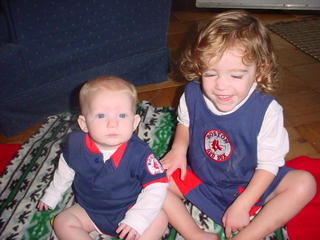
Husband of Renee', father of Ellie Grace and Patrick, Episcopal priest, proud member of Red Sox Nation, compulsive reader, so-so blogger
Previous Posts
- a couple of points from hall's chapter 2 i found i...
- how individualism treats the patristics
- play ball!
- sam's on
Archives
Wednesday, September 08, 2004
Tuesday, August 10, 2004
how individualism treats the patristics
caleb's dead on about how the modern/pomo (the latter more than the former) reader's hold their critique of the fathers' "bias" in one hand, like a bright, shiny apple, while (watch for it . . . ) the other hand sneaks in a little "autonomous reflection." i don't want to make it sound conspiratorial; most of it's probably innocent, even subconsciously done. but cutting ourselves off from the church's past, which is riddled w/ godly authors even aside from the fathers hall focuses on, risks losing our footing on the shoulders of those on whom we stand. the fathers did study scripture in secret, i'm sure, but they understand interp as "an ecclesiastical activity to be practiced in the church and for the church within the context of prayer and worship (preface, p. 9). individual study times, lecio divina, small-group bible studies are all good, and they give much to the collective wisdom of biblical interpreters; but to study only in those venues -- or w/o the necessary components of respect for scripture and obedience to it -- is far more prone to error than interpretation as a "communal act." (9)
@ the outset, however, we do well to heed luther's warning to let scripture stand above both the fathers (who were capable of fallacy) as well as above our modern, "enlightened" reason. (13) the sola boys, luther and calvin, didn't just jettison "the history, councils, creeds and tradition of the church, including the fathers' writings," instead they recognized the richness of the patristic writings that we ignore to our peril. (13-14) institutions that teach that hermeneutic do tend to cut theology off "from the very religious community in which theological exploration and reflection finds its roots." (15) oden's point is well taken: we risk developing myopia and becoming unable to see over the theological walls we've built w/ all our shiny new exegetical tools. we must, oden writes:
listen intently, actively, without reservation. listen in such a way that my whole life depended upon hearing. listen in such a way that i could see telescopically beyond my modern myopia, to break through the walls of my modern prison, and actually hear voices from the past w/ different assumptions entirely about the world and time and human culture. (18)that's something i hope i can learn alongside you guys: the tell-tale signs of my own individuality as i interpret the text, and the cheap way i handle scripture when i don't really intend for it to inform my thoughts and shape my character. i'm gonna need a little help to get there, boys, but i agree w/ caleb that identifying the disease is the first step to finding good medicine.
Tuesday, August 03, 2004
play ball!
i've started the book, and i like it so far. somebody define a reasonable block o' text w/ which to start off our discussion.